Dante Loriman
Hold TightDante Loriman is Susan Loriman’s husband and Lucas Loriman’s father in the family life they share, though not his biological father. The distinction becomes urgent when Lucas needs a kidney: medical testing makes genetic compatibility visible, while Dante’s insistence on helping shows a commitment that cannot be measured by a match. His story also turns on an asymmetry of knowledge. Susan has kept the circumstances of Lucas’s conception from him, while Dante continues to act as Lucas’s father without knowing what she has concealed.
Identity and First Impressions
Dante first appears through other people’s assessments rather than through an account of his own history. Mike Baye regards him warily: the polished exterior, conspicuous jewelry, strong cologne, and self-conscious masculinity suggest to Mike a man trying to project confidence. Mike has heard rumors that Dante may have connections to organized crime, but the narration explicitly leaves their basis uncertain, allowing the rumors to remain an impression rather than a fact. Tia Baye, by contrast, finds his look a welcome change from the clean-cut men around her. This difference establishes Dante as someone whose appearance invites sharply different readings without proving either one correct.
A brief exchange about prescribing something also conveys a point of friction: Susan says Dante does not believe in that sort of treatment. Mike offers to speak with him, but Susan declines. The moment supplies no diagnosis or detailed account of Dante’s views; its significance lies in the contrast between Mike’s impulse to intervene and Susan’s decision not to enlist him. Dante is present in the family’s choices even when he is not in the room.
Fatherhood and the Donor Tests
The question of Lucas’s biological paternity surfaces in a conversation between Mike and Ilene Goldfarb. Ilene tells Mike that Dante is not Lucas’s biological father, a revelation that briefly leaves him stunned. The disclosure reframes the family’s medical situation: Lucas needs a kidney, and the search for a suitable donor makes biological relationships consequential in a way they had not been before.
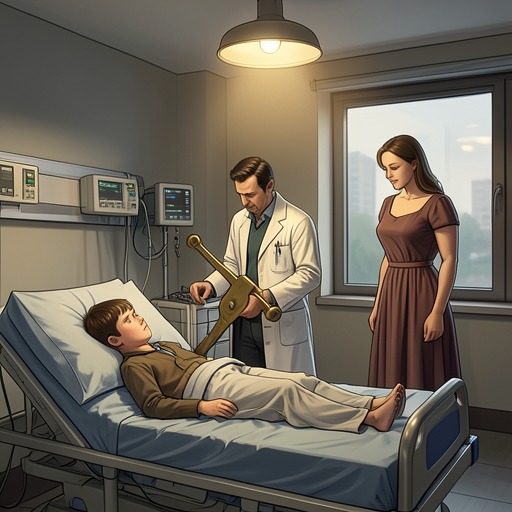
At a meeting in Ilene’s office, Dante arrives with Susan. He shakes Mike’s hand firmly, then sits without looking at his wife. As Ilene prepares to discuss the tissue-typing results, Dante interrupts to insist that he wants to be the one to give Lucas a kidney. His response comes before the discussion of whether he is medically suitable. The sequence gives his wish its own force: he does not wait for a favorable result before claiming the responsibility.
The tests nevertheless distinguish his willingness from his compatibility. Ilene explains that the desired HLA match involves six antigens and tells Dante that his results do not make him a good candidate. Susan is a better match, though not a perfect one. Dante’s reaction suggests that he had expected a father to be a likely match; the medical explanation unsettles that expectation without changing his stated wish to help. In the scene, biology is not an abstract secret. It becomes a set of test results that can affect Lucas’s chance of receiving a kidney, while also exposing the limits of what family members assume blood will mean.
Susan’s Secret and Their Marriage
Dante does not know the truth Susan has kept from him. In a later conversation with Ilene, Susan finally says that she does not know who Lucas’s biological father is. She explains that, when she became pregnant, she hoped Lucas was Dante’s; after Lucas was born, she suspected otherwise and pushed the knowledge aside. She never told Dante, or anyone else. Her account makes clear that the disclosure to Mike and the medical testing have revealed a secret to other characters without yet making it shared knowledge within the marriage.
The subject returns in Susan’s private reflections as she and Dante work to find a donor. She recognizes that biological inheritance does not define Dante’s place in Lucas’s life: she thinks of him as Lucas’s true father. At the same time, she remains conscious of the lie and of the unresolved past behind it. Her gold cross, inherited from her mother, accompanies these thoughts; the object links Susan’s sense of guilt to the family history she has carried privately. The tension is not simply between a biological father and a non-biological one. It is between the father Lucas has known and the truth Susan has not trusted herself to tell him.
Care, Action, and Narrative Significance
Dante’s commitment appears not only in the transplant meeting but in the practical work of finding help. Susan tells Mike that she and Dante are planning a major donor drive at Lucas’s elementary school. She has spoken with teachers, who support the idea, and intends to invite people to register with the donor bank. The effort expands the search beyond the immediate family: when the tests do not produce an ideal match at home, they turn toward a wider community of potential donors.
Later, Dante comes up behind Susan in the garden and places his hands on her shoulders, asking whether she is all right. He tells her that they will save Lucas and promises that his own family will be tested. Susan accepts his reassurance but still keeps the secret to herself. Dante, for his part, gives her space when she wants to be alone and does not press her to explain moments of withdrawal that have become new in their marriage. The scene shows intimacy expressed through presence and practical promises rather than through knowledge of everything the other person carries.
Dante’s significance rests on the contrast between biological evidence and lived responsibility. The test results exclude him as a strong donor candidate, but they do not erase his place as the person who raises Lucas, wants to give him a kidney, recruits others to help, and promises to keep searching. Susan’s secret complicates that devotion without making it false. The available scenes leave the central question of disclosure unresolved: Dante continues to act on a father’s commitment while Susan alone knows why the distinction between biological and familial fatherhood has become so painful.